Showing posts with label biology. Show all posts

July 22, 2017

Structure of a cell

Cell theory


  1. all living things are composed of one or more cells
  2. the cell is the basic unit of life
  3. new cells arise from pre-existing cells

Prokaryotic and Eukaryotic cells


  • 4 key components of cell: plasma membrane, cytoplasm, DNA, ribosomes
  • prokaryotic cells are one single open space(without membrane walls inside)
  • prokaryotic DNA is in nucleoid
  • the surface-area-to-volume ratio(exchange capacity of the cell) regulates cell size

Eukaryotic cells


  • membrane bound nucleus
  • a number of membrane-bound organelles
  • multiple linear chromosomes

Plasma membrane and cytoplasm


  • plasma membrane: a double layer consists of phospholipids, divides in&out of the cell
  • its two-layer structure called a phospholipid bilayer
  • cytoplasm: everything found inside the plasma membrane(in prokaryotes), between the plasma membrane and the nuclear envelope(nucleus)(in eukaryotes)
  • cytosol=goo

Nucleus and ribosomes


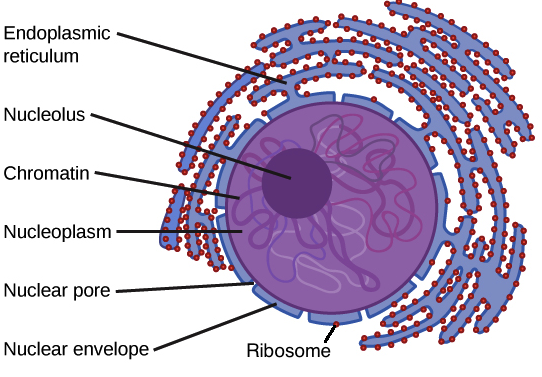
  • nuclear envelope: made up of two layers of membrane
  • in the space between the two layers: endoplasmic reticulum
  • nucleolus: new ribosomes are assembled(by ribosomal RNA)


  • in prokaryotes DNA is organized into a loop structure chromosome
  • in eukaryotes DNA is organized into a string structure chromosome


  • endoplasmic reticulum: rough one(with ribosomes)/ smooth one(without ribosomes)

The endomembrane system


  • a group of membranes and organelles in eukaryotic cells
  • nuclear envelope/ lysosomes/ endoplasmic reticulum/ Golgi apparatus and the plasma membrane

The endoplasmic reticulum


  • the rough endoplasmic reticulum(rough ER): ribosomes(attached to its cytoplasmic surface) make proteins>packaged into vesicles>shipped to the Golgi apparatus
  • the smooth endoplasmic reticulum(smooth ER): no ribosomes. synthesis of carbohydrate/lipids/steroid hormones, detoxification, storage(of calcium ions)

The Golgi apparatus


  • cis face(the receiving side)>modify proteins and lipids>tagged and sorted, packaged into vesicles(again)>trans face(exit)>bud from the Golgi


  • lysosomes: an organelle contains digestive enzymes(in plants cells, called vacuole)
  • phagocytosis(process): pathogen(like a virus) engulfed by macrophages(white blood cell)>a phagosome contain pathogen>lysosome involve, destroy the pathogen

Mitochondria and chloroplasts


  • Mitochondria act as the powerhouse of the cell, through cellular respiration
  • Chloroplasts act the same for plants and algae, through photosynthesis
  • photosynthesis
  • thylakoid: contains light-harvesting complexes that include chlorophyll 
  • Mitochondria make adenosine triphosphate(ATP)
  • ATP making process=cellular respiration

The cytoskeleton


  • 3 types of protein fibers in the cytoskeleton(in eukaryotes)
  • microfilaments: the narrowest, made of actin, highways inside the cell 
  • intermediate filaments: specialized to bear tension, maintain the shape of the cell
  • microtubules: help the cell resist compression forces
  • microtubules are components of eukaryotic cell structure: flagella, cilia, centrosomes
  • flagella: like a moving tale of a sperm
  • cilia: like a short hair in nostrils(nose holes)
  • both have 9+2 array


  • centrosomes consists of 2 centrioles(=modified basal body)
  • centrosomes: microtubule organizing center, its exact function is at open research

Extracellular structures and cell-cell junctions


  • extracellular matrix(ECM): a complex meshwork of proteins and carbohydrates, a major component is the protein collagen


  • proteoglycan complex: interwoven with collagen fibers
  • integrins: embedded in the plasma membrane. anchor the cell, sense its environment(ex. blood clotting)
  • fibronectin: act as bridges between integrins and other ECM proteins(collagen)
  • cell wall: plant's supportive extracellular structure(collagen for animals), a major organic molacule is cellulose

Cell-cell junctions


  • plasmodesmata: have a hole to allow direct cytoplasmic exchange between two cells
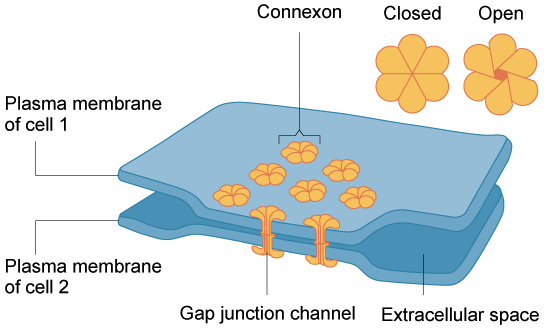
  • gap junctions: channels between neighboring cells, 6 connexins=a connexon 


  • tight junctions: create a watertight seal between two adjacent animal cells(ex. our bladder) 
  • claudins: tight junction proteins
  • desmosomes: junctions of animal cell. pin adjacent cells together, ensuring stretching skin or muscle remain connected in an unbroken sheet
  • cadherins: adhesion(sticking) proteins, hold the membranes together

July 10, 2017

Membranes and transport

The components of the plasma membrane


  • Phospholipids: main fabric
  • Cholesterol: tucked between the hydrophobic tails(core of the membrane)
  • integral proteins: embedded the bilayer
  • peripheral proteins: on the inner or outer surface, not embedded
  • carbohydrates: (attached to proteins or lipids)on the extracellular side

Diffusion and osmosis


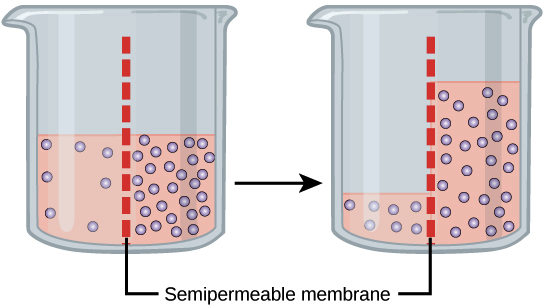
  • osmosis: the net movement of water across a semipermeable membrane from lower concentration to higher concentration
  • diffusion: molecules move from higher concentration to lower concentration as a result of probabilities

the solute molecules physically knocking the water molecules backwards, making them less likely to cross

  • tonicity: the ability of an extracellular solution to make water into or out of a cell by osmosis
  • osmolarity: the total concentration of all solutes in the solution
  • *only solutes that cannot cross the membrane
  • hypotonic: extracelluar's osmolarity lower, inside the cell's higher(water out to in)
  • hypertonic: extracelluar's osmolarity higher, inside the cell's lower(water in to out)
  • isotonic: both's osmolarity same(no net movement of water)

Passive transport


  • does not require to expend energy bc a substance diffusing down its concentration gradient
  • concentration gradient: a region where the concentration of a substance changes(from higher to lower)
  • non polar and small molecules readily diffuse across(carbon dioxide, oxygen..)
  • polar and charged molecules have trouble crossing the core membrane
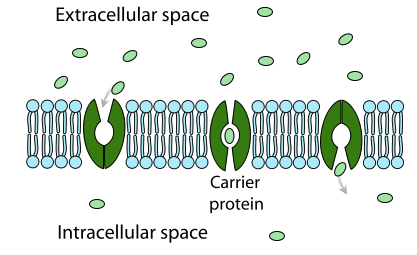
  • facilitated diffusion: channels and carrier proteins

Aquaporins: channel for water molecules

carrier proteins: change shape in response to binding of their target molecule

Active transport

  • the cell expends energy(ATP) to move substance against its concentration gradient
  • membrane potential: an electrical potential difference(voltage) across cell membrane
  • inside of the cell having extra negative charges(generally -40 to -80 millivolts)
  • electrochemical gradient: the combination of concentration gradient and voltage(that affects an ion's movement)
  • Active transport-primary active transport: sodium-potassium pump

sodium-potassium pump

  • move Na+ out, K+ into cells 
  • uses ATP as an energy source
  • generating the voltage across the membrane(electrogenic pumps)

The sodium-potassium pump cycle

  1. the pump is open to the inside of the cell, take up 3*Na+
  2. trigger the pump to hydrolyze ATP(phosphorylation, phosphate group attach to the pump)
  3. phosphorylation make the pump change shape, release 3*Na+
  4. the pump take up 2*K+, triggers removal of the phosphate group attached to the pump
  5. with the phosphate group gone, the pump change back to its original shape
  6. the pump release 2*k+, back to step 1

membrane potential generated by the pump

  1. too many K+ inside the cell(since the pump), the gradient is very steep
  2. K+ move out of the cell(via channels), negative charge inside is growing
  3. (negative charge inside big enough)K+ stops being imported, the voltage(difference, not flow)disappear

Secondary active transport

  • the electrochemical gradients store energy
  • secondary active transport uses the energy to move other substances against their own gradients
  • when Na+ return to the interior of the cell via channel or carrier protein, glucose share the carrier(as a cotransporter)
  • cotransporter: symporter(both move same direction) and antiporter(move in opposite direction)

Bulk transport

  • Endocytosis: move particles into a cell by enclosing them in vesicle
  • Phagocytosis: cell-eating, large particles are transported into the cell
  • Pinocytosis: cell-drinking, cell takes in small amounts of extracellular fluid
  • Receptor-mediated endocytosis: receptor proteins(on the cell surface) capture a specific target molecule *they cluster in coated pits(ex. Clathrin)
  • Exocytosis: materials are transported from the inside to the outside of the cell(like from the Golgi apparatus)

June 28, 2017

Energy and enzymes

Overview of metabolism

  • breaking down glucose=cellular respiration
  • C6H126O6+6O2 -> 6CO2+6H20+energy
  • which energy captured by the ATP(adenosine triphosphate)
  • which is the energy currency of the cell
  • building up glucose=photosynthesis
  • anabolic(building up) needs energy
  • catabolic(breaking down) releases energy

Laws of thermodynamics

  • types of energy: kinetic/thermal(constant moving of atoms or molecules)/potential/chemical... 
  • types of system: open(energy, matter exchange)/closed(only energy)/isolated(both not exchange) system
  • The first law of thermodynamics: energy cannot be created or destroyed, it can only change or be transferred
  • The second law of thermodynamics: every energy transfer will increase the entropy of the universe(reduce the amount of usable energy) 
  • the system will tend to move towards more disordered configuration bc it's statistically much more likely
  • system hates temperature-separated(organized) configuration!

Free energy

  • Gibbs free energy change equation: △G=△H-T△S
  • G means the change in free energy of a system(from initial to final)
  • △G<0 a reaction proceed spontaneously(without adding energy) △G>0 need an input of energy
  • H means the enthalpy(energy stored in bonds) change. 
  • △H<0 release heat, △H>0 absorb heat(from reactant to product)
  • T means temperature
  • S means the entropy change of the system
  • △S<0 become ordered △S>0 become disordered(have more potential states)
  • Endergonic reactions: require an input of energy(△G>0), non-spontaneous
  • Exergonic reactions: release free energy(△G<0), spontaneous reactions
  • ADP(adenosine diphosphate)+Pi+△G(=+7.3kcal/mol) -> ATP+H20 
  • the energy needed to make ATP is provided, for example, glucose

ATP and reaction coupling

  • ATP(Adenosine triphosphate) is unstable due to negative charges in its phosphate tail
  • phosphoanhydride bonds: bonds between the phosphate groups, high-energy
  • ATP+H20 <-> ADP+Pi+energy
  • △G for the hydrolysis of 1 ATP into ADP(+Pi)=-7.3kcal/mol(=-30.5kJ/mol) @standard conditions
  • -14kal/mol(=-57kJ/mol) @in a living cell 
  • ATP in reaction coupling: the formation of sucrose
  • the first reaction: a phosphate group is transferred from ATP to glucose, forming "glucose-P(glucose 6 phosphate)"
  • Hexokinase: provides ions(Mg), make electrons(O- in phosphate tail) busy

  • the second reaction: glucose-P intermediate reacts with fructose to form sucrose

Introduction to enzymes

  • transition state: to break the bonds, molecules must be bent, unstable state, at higher energy level than both reactants and products
  • activation energy(EA): initial energy input to proceed the reaction(independent to whether it's endergonic, exergonic)
  • catalyst=enzymes: lower the activation energy, increase reaction rate
  • (enzyme's)substrate
  • active site
  • environmental effects on enzyme: temperature, pH(if both extreme, enzyme denature)
  • induced fit

Enzyme regulation

  • enzyme cofactor: non-protein part of an enzyme, help the enzyme do its function
  • organic cofactor=coenzyme like NAD(NAD+H-->NADH)
  • regulatory molecules: molecules regulate enzyme. activator(encourage), inhibitor(discourage)
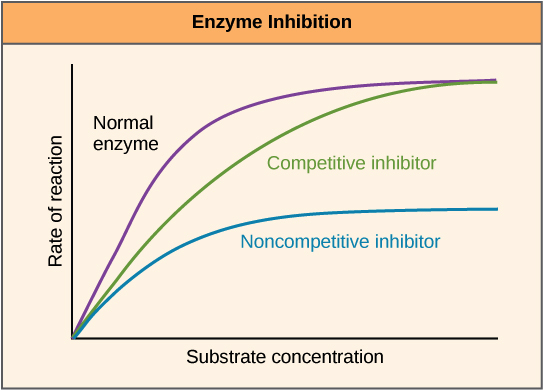
  • competitive inhibition: substrate and inhibitor compete for the enzyme(active site). one attached, another can't. 
  • allosteric competitive inhibition: inhibitor attach to a not-active site, which prevents substrate from attaching the active site
  • noncompetitive inhibition: both can attach to an enzyme, but the activity doesn't happen. 


  • V0(initial velocity): the amount of product/unit at the start of reaction
  • Vmax(maximum velocity): the maximum rate of reaction, depends on enzyme concentration
  • Vmax/2=Km: how quickly reaction rate increases with substrate concentration, altered by inhibitors
  • with a competitive inhibitor: Vmax is unchanged(with more substrates, can reach the normal Vmax), Km is higher
  • with a noncompetitive inhibitor: Vmax is lower than normal Vmax, Km is unchanged(bc inhibitors lower the number of (usable)enzyme)
  • Michaelis-Menten equation

June 22, 2017

Macromolecules

Carbohydrates

  • Carbohydrates: molecules made of carbon, hydrogen and oxygen(rone carbon+one H20 ratio)
  • carbohydrate chains: 
  • monosaccharides
  • disaccharides
  • polysaccharides

Monosaccharides

  • the position of the carbonyl(C=O) group categorize the sugars:
  • glucose has an aldehyde(H-C=O) group, it is aldose
  • fructose has the carbonyl group with its #2 C, it is ketose(forms a ketone group)
  • Glucose and its isomers
  • monosaccharide: glucose, galactose, fructose have the same chemical formula(C6H12O6)
  • isomers: differ in the organization of their atoms
  • glucose and galactose=stereoisomers

Ring forms of sugars

  • glucose's main configuration: 6-membered ring(pyranose)
  • fructose's main configuration: 5-membered ring(furanose)
  • glucose's alpha form and beta form

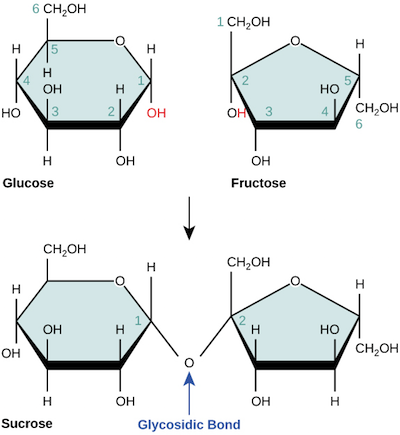
Disaccharides and dehydration reaction

  • Dehydration reaction=condensation reaction, dehydration synthesis <-> Hydrolysis
  • the hydroxyl(OH) group+H of another > releasing H2O and forming a glycosidic linkage(kind of covalent bond)
  • glucose-O-fructose=sucrose highlight is a glycosidic linkage
  • 1-2 glycosidic linkage=1 carbon of glucose-O-2 carbon of fructose

  • disaccharides: lactose(glucose+galactosee), maltose(glucose+glucose), sucrose(glucose+fructose)
  • Polysaccharides: starch, glycogen, cellulose, chitin.. 

Storage polysaccharides

  • starch: the stored form of sugars in plants
  • a mixture of amyose and amylopectin *alpha form
  • Amylose: unbranched chains of glucose monomers connected by 1-4 linkages
  • Amylopectin: branched chains of glucose monomers, most is 1-4 but 1-6 occur periodically
  • *cellulose is made of glucose monomers in their beta form
  • *chitin resembles cellulose

Lipid

Triglycerides

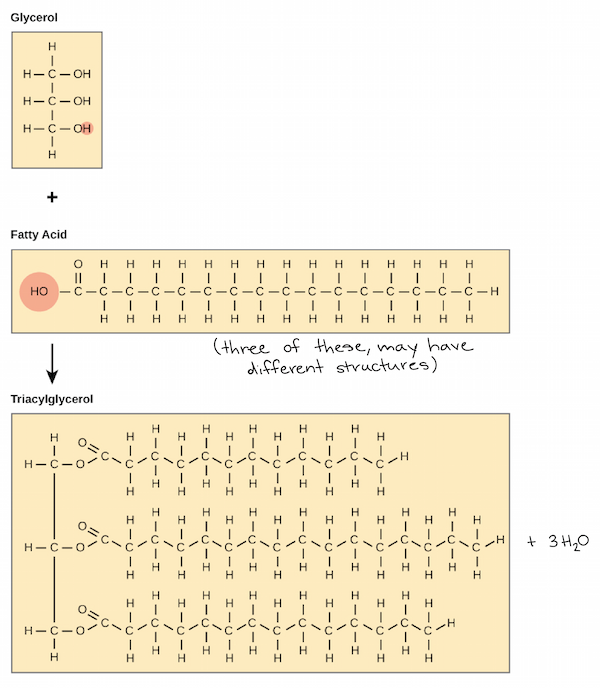
  • triglycerides(in blood)=fat=trayacylglycerol: a glycerol backbone+3 fatty acid tails
  • glycerol: an organic molecule with 3 hydroxyl(OH) groups
  • fatty acid: a long hydrocarbon chain attached to a carboxyl(C=O-OH) group
  • the hydroxyl groups(on the glycerol backbone)-"dehydration synthesis reaction"-the carboxyl group(of fatty acids)
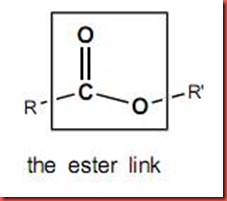
  • it yields 3 fatty acid bound to glycerol via ester linkage
  • *acyl group is a kind of carbonyl group
  • *as a whole, fatty acid is not soluble despite it has a polar head but also has a longer non-polar carbon chain

Saturated and unsaturated fatty acids

  • saturated: only single bonds between neighboring C in the hydrocarbon chain
  • solid at room temperature, dense like butter
  • unsaturated: hydrocarbon has a double bond(monounsaturated) or double bonds(polyunsaturated)
  • liquid form at room temperature, less dense like oil
  • cis configuration: 2 H on the same side, makes bent
  • trans configuration: 2 H on the opposite side, makes no bent, bad for health

Other lipids 

  • (bees)waxs, phospholipids, steroids, cholesterol(the most common steroids)...
  • phospholipids: major components of the membrane
  • has a backbone of glycerol and 2 fatty acid tails
  • 3rd C of the glycerol backbone is occupied by a phosphate group
  • amphipathic molecule means: has a hydrophobic part and hydrophilic part

Proteins

Amino acids

  • the building block of proteins
  • consists of: alpha carbon, amino group(NH2), carboxyl group(COOH) and H
  • in physiological pH condition: 
  • amino group is protonated(grab H), bears a positive charge
  • carboxyl group is deprotonated(throw H), bears a negative charge
  • R group defines amino acids

Peptide bonds

  • carboxyl group(of the amino acid) reacts with the amino group(of an incoming amino acid)+releasing a water molecule
  • directionality: amino terminus(N-terminus)on the left and carboxyl terminus(C-terminus) on the right

Protein structure

  • Primary structure: the sequence of amino acids in a polypeptide chain
  • Secondary structure: local folded structures within a polypeptide, due to interactions between atoms of the backbone
  • a(alpha) helix, B(beta) pleated sheet: carbonyl O+amino H
  • in an a helix: the carbonyl O is (hydrogen)bonded to amino H that is 4 down the chain(amino acid #1+amino acid #5)
  • B pleated sheet has parallel and antiparallel form
  • Tertiary structure: 3D structure of a polypeptide, due to interactions between the R groups(side chains)
  • R group interactions: the whole series of non-covalent bonds
  • Disulfide bonds: one special type of covalent bond in tertiary structure, between the sulfur-containing side chains of cysteines
  • Quaternary structure: for some proteins made up of multiple polypeptide chains(subunits)
  • same interactions that contribute to tertiary structures hold the subunits, form quaternary structure

Nucleic acids


  • nucleic acids made of nucleotides
  • 2 varieties: deoxyribonucleic acid(DNA), ribonucleic acid(RNA)
  • in eukaryotes DNA found in the nucleus(in membrane-bound vault)
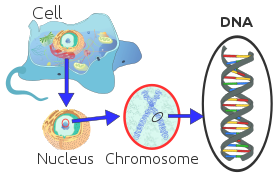
  • and DNA broken up into chromosomes
  • in prokaryotes DNA found in the nucleoid(not in membrane-bound container)
  • central dogma: DNA-RNA copy(messenger RNA, mRNA)-ribosomes(molecular machine to build proteins)

Nucleotides


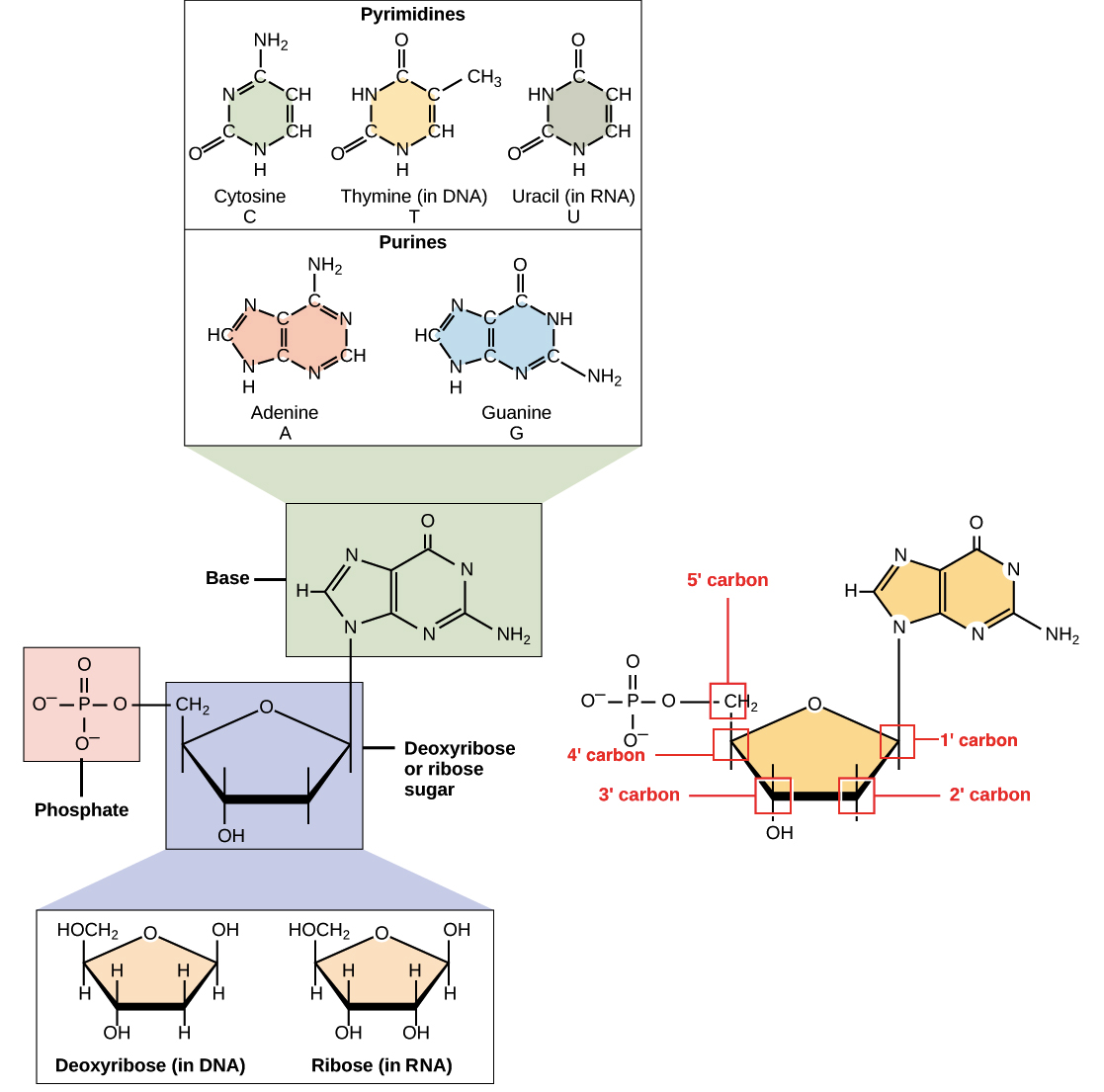
  • Nucleotides made up of: nitrogenous base, five-carbon sugar, at least one phosphate group


  • nitrogenous bases: adenine(A), guanine(G), cytosine(C), thymine(T)
  • A, G is purines and C, T(U in RNA) is pyrimidines
  • purines must pair with pyrimidines, A-T and G-C
  • the five-carbon sugar in DNA is deoxyribose, in RNA, ribose
  • polynucleotide chains by phosphodiester linkage: 5' to 3' direction and 3' to 5' direction(antiparallel)

sugar-phosphate backbone

  • mRNA: intermediate between a protein coding gene&protein product
  • rRNA: ribosomal RNA, a major components of ribosomes
  • tRNA: transfer RNA, carry amino acids to the ribosome


June 16, 2017

Properties of carbon

Carbon

  • C has an atomic # of 6
  • means it has 6 protons, 6 electrons in a neutral atom
  • making a covalent bond with remaining 4 electrons in the outermost shell(valence shell)
  • Hydrocarbons: organic molecule consisting entirely of C and H
  • a key structure component of most macromolecule
  • ex. methane, ethane, propane, butane.. (underline means # of C. 1,2,3,4...)
  • tetrahedron

Hydrocarbon structures and isomers

  • Ethane(C2H6): tetrahedral(single bond), can rotate freely
  • Ethene(C2H4): planar(double bond), unable to rotate *planar means two dimentional 
  • Ethyne(C2H2): linear(triple bond)
  • Isomers: same chemical formula, differently connected or arranged
  • Cis&trans isomers: atoms connected in the same order, differ in the configuration of atoms
  • cis-2-butane: methyl groups(H3C, CH3) on same side
  • trans-2-butane: methyl groups on opposite side
  • Enantiomers: same chemical structure and different 3 dimensional placement of atoms(like a mirror image)

Functional groups

  • Hydroxyl: polar, R-O-H
  • Methyl: nonpolar, not dissolve in water, R-CH3
  • Carbonyl: polar, O=C
  • Carboxyl: charged, OH, acidic(ionize to release H+)
  • Amino: charged, N, basic(remove H+ from solution)
  • Phosphate: charged, P, acidic
  • Sulfhydryl: polar, R-S-H
  • R means the rest of the molecule that the group is attached to

June 14, 2017

Biology : Water, acids, and bases

Hydrogen bonding in water

Hydrogen bonding in water

  • hydrogen bond
  • oxygen is more electronegative(electron-greedy) than hydrogen
  • that gives the oxygen end of the water molecule a partial negative charge
  • hydrogen has a partial positive charge
  • water is classified as a polar molecule
  • is attracted to other polar molecules and to ions

Solvent properties of water

  • solvent+solute=solution
  • water is good at dissolving ions and polar molecules
  • poor at dissolving nonpolar molecules
  • water can form electrostatic interactions(charge-based attractions) with other polar molecules and ions
  • hydration shell
  • it allow particles to be dispersed(spread out) evenly in water
  • into the water, NaCl to dissociate(break apart) into Na+ and Cl- ions
  • hydration shell is formed around each ions which would be dispersed

Cohesion and adhesion

  • cohesion: the attraction of molecules for other molecules of the same kind
  • water's cohesive force: thanks to their ability to form hydrogen bonds with one another
  • cohesive force: are responsible for surface tension
  • adhesion: the attraction of molecules for other molecules of a different kind
  • ex. capillary action: the upward motion of water molecules in a thin tube
  • capillary action = water&glass(adhesion) + water&water(cohesion)
  • meniscus that water shows, bc glass molecules are even more polar than water molecules(glass's O(with Si) is stronger negative charged than water's O(with H))
  • thus, water's H is going to be attracted to the glass even harder than each other

Temperature and state changes in water

  • liquid water: hydrogen bonds are being formed and broken by the energy of motion(kinetic energy, vibration)
  • gas: the higher kinetic energy caused the hydrogen bonds to break completely, allow water molecules to escape into the air
  • solid: too little heat energy left to break the hydrogen bonds
  • density of ice: the water molecules are pushed farther apart than they are in liquid form
  • specific heat capacity: the amount of heat(to break hydrogen bonds) needed to raise the temp of 1g of a substance by 1 degree celsius(for water, calorie)
  • heat of vaporization: the amount of energy needed to change 1g of a liquid substance to a gas(at constant temp), 540 cal/g at 100'c
  • evaporative cooling: the molecules with the highest energy escape away from other molecules

Acids, bases, and pH

Autoionization of water

  • autoionization of water: H20 <-> H+(aq)hydrogen ion+OH-(aq)hydroxide ion
  • this H+ transfer to a neighboring water molecule, form H3O+, hydronium ion
  • the concentration of hydrogen ions produced by autoionization is: 1*10-7M

Acids and bases

  • an acidic solution: high concentration of hydrogen ion than pure water
  • a basic solution: low concentration of hydrogen ion than pure water
  • pH=-log10[H+]
  • neutral pH=pure water's=7
  • generate H+, it goes to acidic
  • release OH-(it absorb H+), it goes to basic(alkaline)
  • an acidic solution: high concentration of hydrogen ion than pure water
  • a basic solution: low concentration of hydrogen ion than pure water

Buffers

  • carbonic acid: a basic form of carbon dioxide enters the bloodstream
  • HCO3-bicarbonate ion <too low H+<<>>too many H+> H2CO3carbonic acid
  • too many H+: bicarbonate ion absorbs H+ >> turn into carbonic acid
  • too low H+: carbonic acid release H+ >> turn into bicarbonate ion

June 1, 2017

pH stories

Here is a fun article about making 'glowing sushi' with a glowing protein, called GFP.

article

ok, then what about the glowing beer? Is it possible to brew the glowing beer with the yeast where GFP can be activated? According to the article, the answer is no. Because the glowing protein actually is dependent on pH conditions, and a majority of target pH of finish products is below pH 3~4 where there is no way to activate for GFP.
Then, why does pH condition go down during beer fermentation? I googled.

1.
(from there)
Fermentation is the oxidation of organic carbohydrates(means starch) under anaerobic(means no oxygen) conditions.  The classic example is the fermentation of sugars into ethanol and carbon dioxide utilizing yeast for beer and wine production. During this process, CO2 is released into the air in the form of gas bubbles.  But much CO2 is also dissolved in the water solution.  CO2 dissolved in water produces carbonic acid (H2CO3) in small quantities according to the equation below:

H2O + CO2 --> H2CO3

Carbonic acid is a weak acid that will lower the pH slightly.  So this is why the pH changes slightly during fermentation.

2.
(from there)
Substantial factor:
  • Organic acid excreation(means separated from a bigger body)
  • Absorption of basic amino acid(basic blocks that comprise proteins, from malted grains*)

Less extent factor:
  • Solution of carbon dioxide
  • Absorption of primary phosphate(PO3-4)

* leave it for smarter future me... 
What is free amino nitrogen(FAN) link
amino acid link

3.
(from there)
  • pH affects the shape of proteins.
  • (If pH is increased, this affects the shape of proteins, by disrupting bonds in the protein.)
  • Enzymes are responsible for the metabolic processes that occur. 
  • Enzymes are proteins. 
  • Enzymes work best in acidic condition, when pH is lower, which bend the protein into the correct shape to allow fermentation to occur. 
conclusion: lower pH is good for your wort. 

4.
and the good basic lesson about pH for homebrewers is here
leave it for the future me, too.

Yeast cells take in ammonium ions (which are strongly basic, similar to alkaline) and excrete organic acids (including lactic acid)
May 28, 2017

Biology : Chemistry of life

Elements and atoms

  • Proton : defines the element. the numbers of protons in the nucleus of the atom defines. 
  • # of protons = atomic number = what  defines elements
  • For example, Hydrogen has one proton, helium has two protons.. 
  • Electron
  • Neutron
  • proton and neutron in the center of the atom=nucleus of the atom
  • Neutron can change, electron is change, the atom is still the same atom. 
  • protons cannot change. 
  • protons have positive charge.
  • electrons have negative charge.
  • they attract each other.
  • isotope : the same element with a different of neutrons

Electron shells and orbitals

Orbitals

  • the Bohr model : model electrons as planets revolving around a star
  • with more energy, its orbit will become more elliptical
  • as electrons gets more energy, it will enter the higher energy state
  • when eletrons get further away from a high energy state the coulomb force is weaker
  • then they're easier to pluck off
  • the electron configuration : the distribution of electrons of an atom or molecule (or other physical structure) in atomic or molecular orbitals.
  • Coulomb force : attraction or repulsion(=repel) of particles or objects because of their electric charge. 

More on orbitals and electron configuration

  • electrons fill up the orbitals from lowest energy state to high energy state
  • electron configuration for carbon : 1s2 2s2 2p(no 3s follows)
  • electron configuration for nitrogen : 1s2 2s2 2p3
  • electron configuration for silicon : 1s2 2s2 2p6 3s2 3p2
  • 2p6 it filled up of this p-block over here(from B to Ne)
  • 3p2 in the third periond+second row of the p block

Valence electrons and bonding

  • valence electrons = electrons that atom will use to when it react
  • valence electrons : tends to be with highest energy level/furthest out from the center(for s and p block, not for transition metals )
  • in the same group elements : are going to have same # of Valence eletron
  • Carbon's electron configuration is [He]2s2 2p2
  • How many electrons does it have in its outermost shell=not been completed yet
  • These four [He]2s2 2p2
  • in carbon's group, they are all going to have 4 Valence electrons
  • covalent bond : 
  • Fe(iron)'s electron configuration with Ar(argon) as a base = [Ar] 4s2 3d6
  • transition metals
  • D block : known as transition metals(bridge between s-block and p-block)
  • F block : known as inner transition metals(bridge between s-block and d-block)

Groups of the periodic table

  • the most part the elements in the column(group) have very similar properties\
  • and same bonding behavior
  • because they tend to have the same number of electrons in their outermost shell(=same # of valence electrons)
  • group 1, alkali metals(except for Hydrogen), very reactive(one valence electron left to react)
  • group 2, alkaline earth metals, 2 valence electrons in their the outermost shell, reasonably reactable
  • electron configuration for Sc : [Ar] 4s2 3d1(backfill)
  • group 17, Halogen, love to react with alkali metals
  • group 18, noble gases(=atomic nirvana), have similar properties not being reacted
  • because they have 8 valence electron, filled their outermost shell
  • octet rule : Most of the elements important in biology need eight electrons in their outermost shell in order to be stable
  • Subshells are designated by the letters s, p, d, and f, and each letter indicates a different shape
  • each orbital can hold up to two electrons. p subshell has 3 dimensions then it can hold up to 6 electrons at most. 
  • d orbital, but this orbital is considerably higher in energy than the 3s and 3p orbitals and does not begin to fill until the fourth row of the periodic table

Chemical bonds and reactions

  • Ionic, covalent, and metallic bonds
  • ionic bond : not sharing electrons, just handed over electrons, then attracted force is coming(due to different charges)
  • ionic bond forms ion. cation(positive charge), anion(negative charge)
  • covalent bond : is a chemical bond that involves the sharing of 2 electrons between atoms. (when atoms aren't very different in terms of their electronegativity)
  • polar covalent bond : one side of the molecule is going to be more negative/positive 
  • non polar covalent bond : form between two atoms of the same element, so between atoms of different elements that share electrons equally.
  • metallic bond : they love to share electrons, make a pool of electrons, which make them malleable(easy to bend)

Electronegativity

  • Electron affinity : how much does the atom attract electrons
  • Electronegativity : high or low electron density. when that atom is part of a covalent bond, how likely does it want to hog(keep) electrons in that covalent bond? 
  • in case of H2O, oxygen is more electronegativity, so electrons spend more time around oxygen
  • (on groups)from left to right, it is more electronegative
  • (on period)from top to bottom, it is less electronegative. because atoms on the bottom have more shells, so the electron in the furthest shell is easier to grab off(give up the electron)

Electronegativity and bonding 

  • Pauling scale for electronegativity
  • Oxygen is more electronegative than carbon, it is partially negative.(meanwhile, carbon is partially positive)=polarized situation. polar covalent bond.
  • <->non-polar covalent bond
  • if the difference of electronegativity more than 0.5, consider to be polar covalent bond
  • in case of Na-Cl, the difference of electronegativity(2.1) so big, they're not gonna share electrons. Cl steals electrons. 
  • Cl gets former negative charge, Na gets former positive charge=the ionic bond
  • if the difference of electronegativity more than 1.7, consider to be ionic bond
  • those numbers(0.5 and 1.7) are not absolute. 

Intermolecular forces

  • means forces between molecules
  • dipole-dipole interaction(acetone molecule)
  • oxygen(partially +), carbon(partially -)=two different poles=polar molecule
  • there's going to be an electrostatic attraction between O(from molecule A) and C(from molecule B)
  • its intermolecular force holds molecules as a liquid at room temperature.
  • it depends on the electronegativity.
  • hydrogen bonding(water molecule) : stronger version of dipole-dipole, the strongest intermolecular force(O-H-O)
  • it need more energy to pull these water(boiling temp. 100'c) molecule apart than acetone(boiling temp. 56'c) 
  • FON : fluorine, oxygen, nitrogen = electronegative atoms participate in hydrogen bonding
  • london dispersion focrces(methane) : the weakest intermolecular force
  • van der Waals forces : a general term for intermolecular interactions that do not involve covalent bonds or ions

Chemical reactions

  • reactants->products
  • coefficients : a number of moleculs participate in the reaction
  • the law of conservation of matter : Equations must be balanced
  • reversible reactions : to the state of equilibrium
  • cation : positively charged ion
  • anion : negatively charged ion